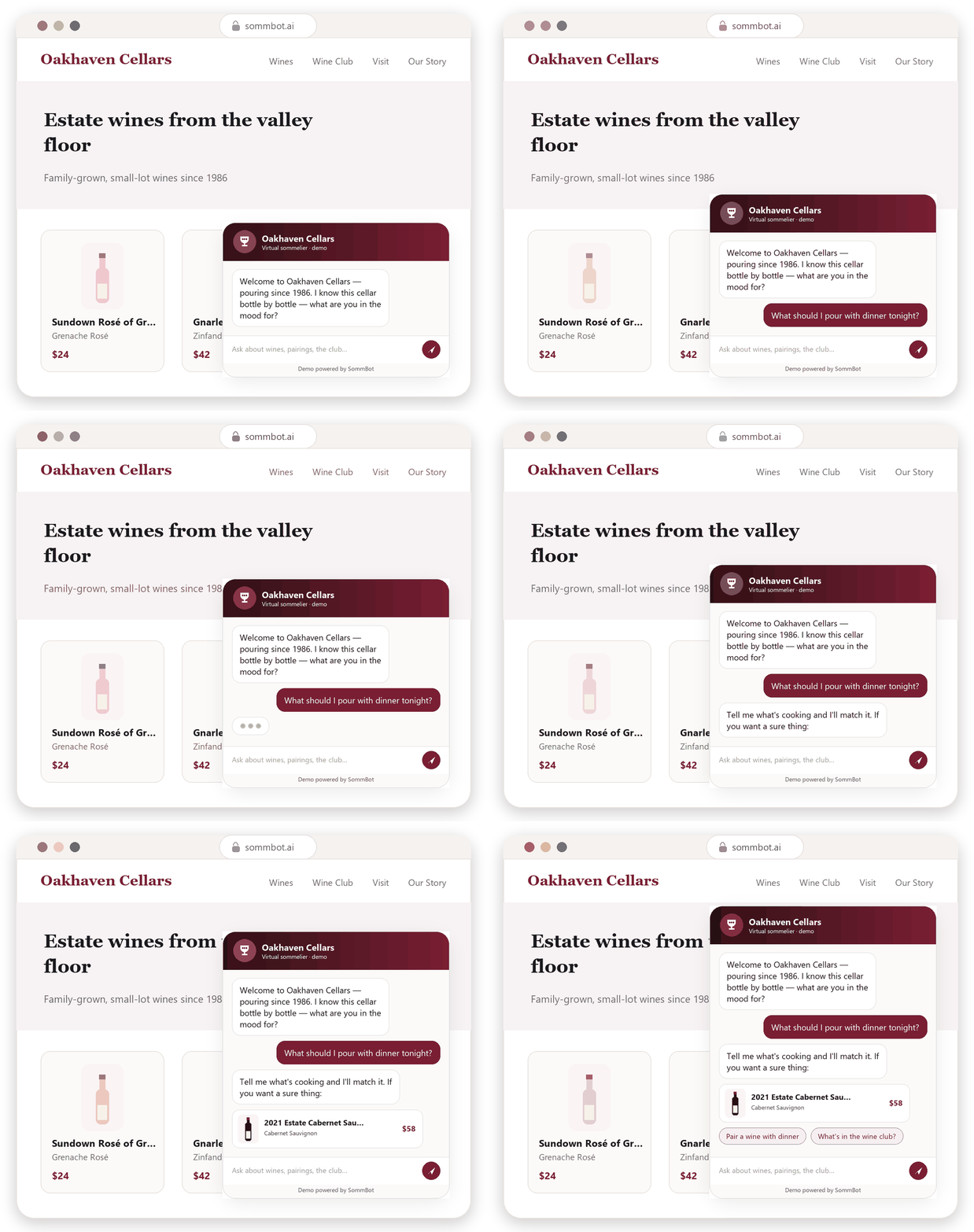
A product description is the closest thing your website has to a person standing next to the bottle. It does the job a tasting-room host does in the room: sets the scene, answers the quiet objection, and makes the next sip feel inevitable. Except it works in silence, on a phone, at 11pm, with no one there to read the customer's face.
Most ecommerce product descriptions fail at this twice over. They either read like a spec sheet nobody asked for, or like poetry that never says what the wine actually tastes like. And now there is a second reader you cannot ignore: the AI assistant, on your site or someone else's, that scans your copy to answer "what pairs with this?" or "is this one sweet?" If your description is thin, that answer will be thin too.
The good news is that the writing that convinces a human also gives an AI concierge accurate material to work from. Write product descriptions for your ecommerce store once, and well, and both audiences win. Here is how to do that without turning every product page into a term paper.
The two readers every product description now serves
The first reader is the shopper. They are skimming, a little skeptical, and mostly trying to answer one question: "Is this right for me?" They do not want a wine-writing thesaurus. They want to know what it tastes like, when they would drink it, and whether it fits the moment they have in mind.
The second reader is the machine. Increasingly, customers do not read your product page at all — they ask a question and expect an answer. A well-built AI concierge like SommBot only answers from approved content: your real catalog, your tasting notes, your shipping and club rules. It will not invent a flavor or guess an ABV. That is a feature, not a limitation — but it means the concierge is only as good as the copy you feed it. A blank tasting note is a blank answer, and shoppers quietly leave at the wine list when they cannot get one.
So the goal is not "write for humans" or "write for AI." It is to write descriptions rich enough that a human is convinced and a machine has something true to say.
Write for the skim, then reward the read
People decide in seconds whether to keep reading. Front-load the payoff, then let the detail follow for anyone who wants it. A simple, repeatable shape works across almost any DTC product:
- Lead with the payoff, not the pedigree. Open with what the wine delivers in the glass — "Dark, savory, and built for the grill" — before you get to appellation and clone selection. The vineyard story is a reward for the interested, not the price of entry.
- Translate the jargon. "Bright acidity" means it makes your mouth water and cuts through fat. Say both. Keep the technical term for credibility and add the plain-language version for everyone who does not have a WSET pin.
- Name the occasion. "Tuesday-night pizza" and "the bottle you bring when you want to look like you know wine" do more selling than "versatile and food-friendly." Concrete beats generic every time.
- Handle the objection out loud. If a red is bold and tannic, say who will love it and who should decant it. Answering the doubt on the page removes the reason to abandon.
None of this requires more words — often it requires fewer, chosen better. A tight, vivid paragraph outperforms four rambling ones, and it gives your concierge cleaner material to quote.
The facts your AI can't invent (and shouldn't guess)
Persuasion sells the wine; structured facts answer the follow-up questions. These are the fields a shopper asks about at the moment of decision and the exact details an AI must have on hand to respond without guessing. Capture them consistently on every product:
- Vintage, varietal or blend breakdown, and appellation
- ABV, residual sugar or a clear dry/off-dry/sweet cue, and oak treatment
- Tasting notes for aroma, palate, and finish — in real language
- Food pairings, serving temperature, and a drink-now-or-cellar window
- Allergen and diet flags (contains sulfites, vegan, fined or unfined)
- Production notes and case count, if scarcity is part of the story
- Shipping states, club eligibility, and gifting options
Fill these in and the same content lets a concierge answer "what pairs with this?" at scale, confirm a wine is vegan, or flag that you cannot ship to a customer's state. Leave them blank and a responsible AI does the right thing — it declines to guess and hands off to a human. That protects you from a bad claim, but it also means a missing field is a missed sale you never see.
A quick before-and-after
Before: "Our 2021 Estate Cabernet Sauvignon is a bold, elegant wine with notes of dark fruit and a smooth finish. Perfect for any occasion."
That sentence describes roughly nine million wines. It gives a shopper nothing to picture and gives an AI nothing to work with beyond "red, dark fruit."
After: "Our 2021 Estate Cabernet is built for red meat and cold nights — blackcurrant and cocoa up front, a savory, tobacco-leaf edge, and grippy tannins that soften with an hour in the decanter. 14.5% ABV, aged 18 months in French oak, dry. Drinking well now through 2030. Pour it with a ribeye, or cellar a few and thank yourself later."
The second version sells harder to a human and simultaneously answers a dozen questions a concierge might get: sweetness, pairing, ABV, decanting, cellaring. Same product, same page — one just does more jobs.
Make it a system, not a one-time polish
The trap is treating descriptions as a launch-day chore you never revisit. New vintages ship, blends change, wines sell out, and copy quietly goes stale. Stale copy misleads shoppers and, worse, teaches your AI to repeat facts that are no longer true.
Build the discipline instead:
Standardize the fields
Use the same structured attributes on every product so nothing important is optional. Consistency is what lets both your storefront filters and your AI reason reliably across the catalog.
Keep copy and catalog in sync
When a vintage rolls over or a wine sells out, the description and the concierge should update together. This is exactly why it pays to keep your catalog and your chatbot in sync — the AI should never be quoting last year's tasting note or offering a sold-out bottle.
Review with conversion in mind
Revisit your best sellers and your quiet underperformers on a schedule. Thin copy on a high-traffic page is one of the cheapest wins in ecommerce CRO for beverage brands, and it compounds: every improvement helps humans convert and makes your AI a little smarter.
Write once, sell twice
You do not have to choose between copy that moves people and data that powers an AI. Rich, specific, honest product descriptions do both — they earn the add-to-cart and hand your concierge the facts to keep selling after hours. It is the same craft the best tasting-room hosts already practice, just written down where the whole internet can read it. If you are curious how that copy performs when a customer can actually talk to it, try the SommBot demo and ask it something a good product page should already answer.