Most beverage brands don't have a traffic problem. They have a choice problem. Someone lands on the site, browses a few bottles, feels a flicker of uncertainty about what they'd actually enjoy, and quietly closes the tab. That visit never becomes a complaint or a support ticket. It just evaporates.
Closing that gap between interest and purchase is exactly what ecommerce CRO — conversion rate optimization — is for. Done well, it isn't a bag of growth-hacking tricks. It's the disciplined practice of finding where real shoppers hesitate and removing the reason they hesitated, one friction point at a time.
Beverage is its own animal. You're selling taste, which nobody can sample online. You're navigating shipping and age-verification rules. And you're often asking a first-time visitor to commit to a club membership or a full case. This field guide walks through where those conversions leak and how to plug them.
What Ecommerce CRO Really Means (and What It Doesn't)
Ecommerce CRO is the systematic process of increasing the share of visitors who take a desired action — buying a bottle, joining the club, booking a tasting — without having to buy more traffic to get there. A small lift in conversion compounds across every campaign, every email, and every dollar you already spend to bring people to the site.
It's worth naming what CRO is not. It is not fake countdown timers, guilt-trip pop-ups, or "only 2 left!" banners that aren't true. Those tactics may nudge a metric this week, but they erode trust — and for a brand built on hospitality and repeat purchases, eroded trust is a terrible trade. Good CRO makes the honest path to purchase easier, not the dishonest one more manipulative.
The mindset that matters most: assume the shopper is smart, busy, and one small annoyance away from leaving. Your job is to remove that annoyance before they hit it.
Where Beverage Shops Leak Conversions
Before you optimize anything, map the journey and find the leaks. In most beverage DTC stores they cluster in a few predictable places:
- The wine list / catalog page. A long grid of near-identical bottles forces shoppers to become experts on the spot. Many won't; they'll bounce. This is often the single biggest drop-off point, which is why it's worth understanding why winery websites lose buyers at the wine list specifically.
- The product page. Tasting notes written for the trade, no guidance on food pairings or occasion, and no answer to "will I like this?"
- The mobile experience. A huge share of browsing happens on phones, where tiny tap targets, slow images, and clumsy filters quietly kill intent.
- The cart and checkout. Surprise shipping costs, an aggressive age gate, forced account creation, or unclear compliance restrictions on where you can ship.
- The post-visit void. Shoppers who almost bought but got interrupted — and never got a reason to come back.
You don't have to fix all of these at once. But you should know which one is costing you the most, and that requires actually watching the funnel rather than guessing.
Fix Product Discovery Before You Touch the Checkout
Here's a counterintuitive truth of ecommerce CRO for beverage: most brands obsess over the checkout when the real bleeding happens far upstream, at discovery. If shoppers never find a bottle they feel confident about, a frictionless checkout has nothing to process.
Make the catalog answer human questions
Real shoppers don't think in varietals and appellations. They think, "something bold for a steak," "a crisp white under $30," "a gift my dad won't have tried." Your filtering and merchandising should meet them there — by occasion, by price, by flavor profile, by pairing — not just by an alphabetical list of grapes.
Add guided selling, not just more filters
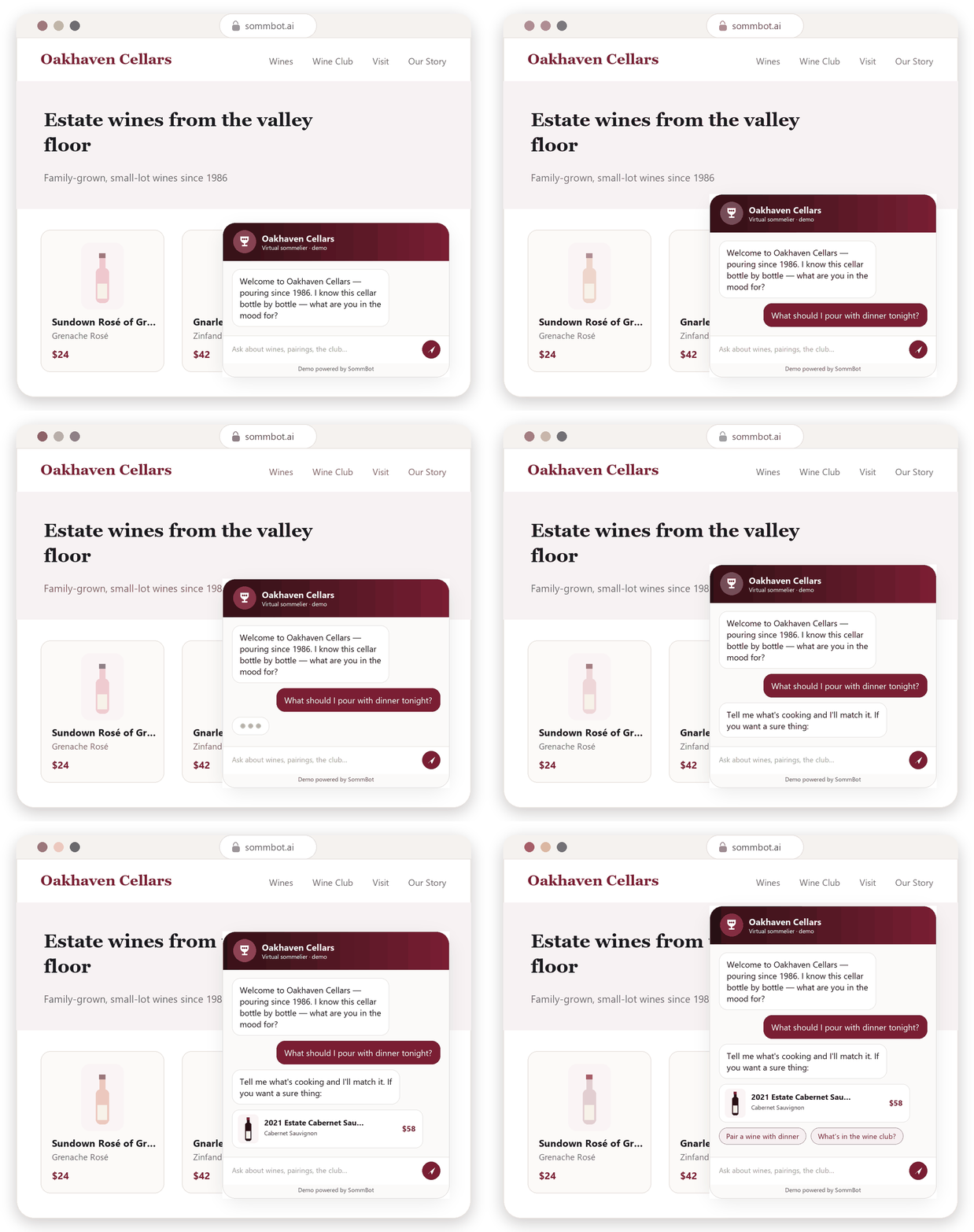
Filters help people who already know what they want. Everyone else needs a guide. This is where a conversational layer earns its keep: a shopper can ask "what pairs with grilled salmon?" or "I liked that dry rosé — what's similar?" and get a specific, on-brand recommendation instead of a wall of options. It's the same instinct that makes a great tasting-room host effective, applied to the website. A well-built AI chatbot can lift ecommerce conversion for CPG brands precisely because it turns a lonely, silent catalog into a conversation.
This is the role a tool like SommBot plays — it sits on your existing store, knows your real catalog and prices, and answers pairing, gifting, and club questions from approved content only, handing off to a human when a question goes beyond what it should answer. It backs up your staff during the hours no one is at the counter; it doesn't replace the hospitality that makes the brand.
Then Attack Checkout and Post-Add Friction
Once discovery is working, tighten the path from "add to cart" to "order confirmed." A few high-leverage moves:
- Show shipping reality early. Surprise costs and "we can't ship to your state" messages at the final step are conversion killers. Surface eligibility and cost as soon as you reasonably can.
- Make the age gate fast and once. Age verification is non-negotiable, but a clumsy or repeated gate adds friction. Keep it clean and compliant — the same principle behind compliance-safe handling of shipping, age-gating, and claims.
- Don't force account creation. Offer guest checkout. You can invite membership after the purchase, when trust is higher.
- Recover the near-misses. Interrupted checkouts are normal, not failures. A thoughtful abandoned-cart recovery approach for beverage and CPG brings back buyers who were genuinely interested — no gimmicks required.
Measure Like a Scientist, Not a Gambler
CRO without measurement is just redecorating. Every change you make is a hypothesis: "clearer shipping info at the cart will reduce checkout abandonment." Treat it that way.
- Change one meaningful thing at a time so you can attribute the result. Ten simultaneous tweaks teach you nothing.
- Watch the whole funnel, not just the final number. A rising add-to-cart rate with flat purchases points you straight at checkout.
- Give changes enough time and volume to mean something before you judge them. Reacting to a single slow day is how good ideas get killed.
Focus on the metrics that connect to revenue rather than vanity signals. If you want a framework for that, our guide to measuring what matters in DTC conversion analytics lays out where to look first.
Start Where It Hurts Most
You don't need a six-month CRO program to see results. Find your single biggest leak — usually the catalog or the checkout — form one honest hypothesis, ship the change, and measure. Then do it again. That loop, run patiently, is how small beverage brands out-convert bigger competitors who are still buying their way to growth.
If your leak is discovery — shoppers who can't decide and leave — that's the gap conversational guided selling was built to close. See how SommBot handles a real product question in a live demo, and picture it working your catalog at 11 p.m. when the tasting room is dark and the visitor is ready to buy.