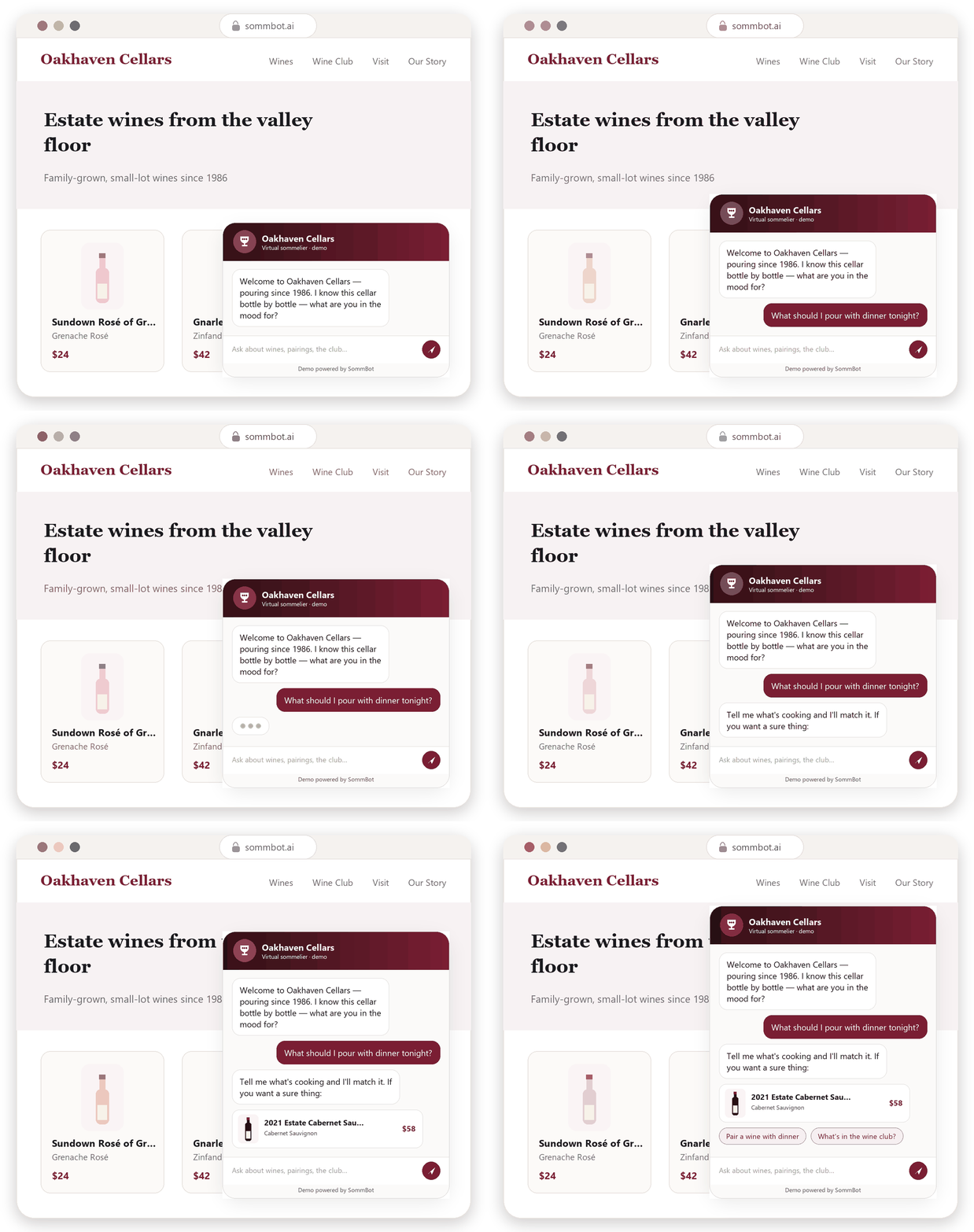
Walk into a good wine shop and something happens that almost never happens online: a person asks you a couple of questions and then hands you the right bottle. "What are you cooking?" "Do you usually like it bold or lighter?" Thirty seconds later you're at the register, confident. That exchange is a sale built on conversation, not on a wall of SKUs.
Conversational commerce is the attempt to bring that exchange to your website. Instead of making shoppers filter, scroll, and guess their way through a catalog, you let them ask for what they want in plain language and get a real answer. For food and beverage brands especially, this isn't a novelty layer bolted onto ecommerce. It's closer to how your products were always meant to be sold.
This primer covers what conversational commerce actually is, why food and drink brands are unusually well-suited to it, and how to start without turning your storefront into a gimmick.
What conversational commerce actually means
Conversational commerce is any buying experience that happens through a back-and-forth exchange rather than a static page. The shopper describes a need; the system responds, asks clarifying questions if it has to, and guides them toward a purchase. It can live in a chat widget on your site, inside SMS, in WhatsApp or Instagram DMs, or even through voice.
The important shift is not the channel. It's the interaction model. Traditional ecommerce is a self-serve library: everything is on a shelf, and finding what you need is your problem. Conversational commerce is a helpful clerk: you say what you're after, and the burden of navigation moves off the shopper and onto the system.
A few things it is not, because the term gets stretched:
- It's not a support bot that deflects tickets. Support is one job; selling is another.
- It's not a decision tree with three canned buttons. Real conversation handles the question you didn't anticipate.
- It's not automatically "AI." A live-chat agent is conversational commerce too. AI simply lets you offer it around the clock without staffing every hour.
Why food and beverage brands are a natural fit
Not every category benefits equally from conversation. If you sell one product in one size, a chat interface is overkill. Food and beverage sits at the opposite end of the spectrum, and several traits stack in its favor.
The catalog is genuinely confusing to outsiders
Varietals, vintages, regions, tasting notes, ABV, format, allergens. A shopper who loves your product may not speak your product's language. They know "something to bring to a dinner with grilled salmon," not "a coastal Chardonnay with restrained oak." Conversation translates. This is the exact failure point where winery websites lose buyers at the wine list, and it's the one conversation is built to fix.
Purchases are occasion-driven
People don't buy a case of wine in the abstract. They buy for a gift, a holiday table, a Tuesday, a party. Occasion is context, and context is exactly what a good conversation surfaces and a filter menu ignores. "What pairs with this?" is one of the most common questions in the category, and it deserves a real answer rather than a dead end. It's worth answering pairing questions at scale the way a sommelier would.
Trust and taste are personal
Food and drink are sensory and subjective. Shoppers want reassurance that they'll actually enjoy the thing, and that reassurance comes from feeling understood, not from a five-star average. A short conversation that reflects a shopper's taste back to them does more for confidence than another badge on the product page. Done right, it carries the warmth of tasting-room hospitality into website conversions.
Where it fits in the buying journey
Conversational commerce isn't a single feature; it's a helper that shows up at several distinct moments. It's worth mapping them, because each one has a different goal.
- Discovery. The shopper doesn't know what they want yet. Here the job is guided selling: ask a couple of questions, narrow the field, recommend two or three bottles instead of eighty. This is the heart of AI guided selling and product discovery.
- Consideration. The shopper has a bottle in mind but a question in the way. Will it ship to my state? Is it in the club? What's the tannin like? Unanswered, these questions quietly kill carts.
- Checkout and after. Shipping timelines, gift options, club terms, order status. Removing this friction is where conversation pays off in fewer abandoned carts and fewer "where is my order" emails.
The brands that get the most from conversational commerce treat it as a thread that runs through all three, not a pop-up that fires once. The same helper that recommends a bottle should also be able to explain your shipping rules and your club.
The line between helpful and harmful
Conversation is powerful precisely because it feels authoritative, and that's also its risk. A confident wrong answer is worse than no answer at all, and in beverage it can cross into compliance territory fast.
Two guardrails matter more than any clever feature:
- Answer only from approved facts. The system should draw on your real catalog, prices, inventory, and policies, and it should decline to guess when it doesn't know. A recommendation for a wine you don't carry, or a price that's three vintages stale, erodes trust instantly. Keeping your product catalog and chatbot in sync is not a nice-to-have; it's the foundation.
- Stay inside compliance lines. Beverage alcohol carries real rules around shipping, age, and health claims. A conversational tool should never invent a shipping eligibility, promise a delivery date it can't guarantee, or make a health claim. When something is uncertain or sensitive, the right move is to hand off to a human, not improvise. This is the whole point of compliance-safe AI for shipping, age-gating, and claims.
This is why "back up staff, don't replace them" is the healthy framing. The tool handles the repetitive, well-understood questions at any hour and quietly routes the rest to a person. This is the model behind a tool like SommBot, which answers from a brand's approved content only, refuses to guess, and hands off when a question needs a human.
How to start without over-engineering it
You don't need to reinvent your website to try conversational commerce. You need to do a few unglamorous things well first.
Get your content in order
A conversational tool is only as good as what it's allowed to say. Before anything else, make sure your product descriptions, pairing notes, shipping policies, and club terms are accurate and written in plain language. This work pays off twice, because the same clear copy that sells on the page also feeds your AI.
Start with your real questions
Pull the actual questions your team fields by email, phone, and live chat. Those are your first hundred conversations. If half your inbox is "do you ship to Texas" and "what's good with steak," you already know what the tool needs to handle on day one. Much of this overlaps with turning a static FAQ page into a real conversation.
Measure the right thing
The vanity metric is chat volume. The real metrics are whether conversations lead to add-to-carts, whether they cut repetitive support load, and whether after-hours shoppers convert instead of vanishing. Start narrow, watch those signals, and expand what the tool covers as it earns trust.
The takeaway
Conversational commerce isn't a trend to chase or a chatbot to slap in the corner of your homepage. For food and beverage brands, it's a return to how these products have always sold best: someone asks what you're looking for, listens, and points you to the right bottle. The web made us forget that. The technology to bring it back is finally good enough, and cautious enough, to trust with a real catalog.
If you're curious what that looks like on your own site and with your own wines, you can see a conversational commerce demo or talk through your catalog with our team. Either way, start with the shopper's question, not the technology, and the rest tends to follow.